AStateIndependent states
Republic of Azerbaijan
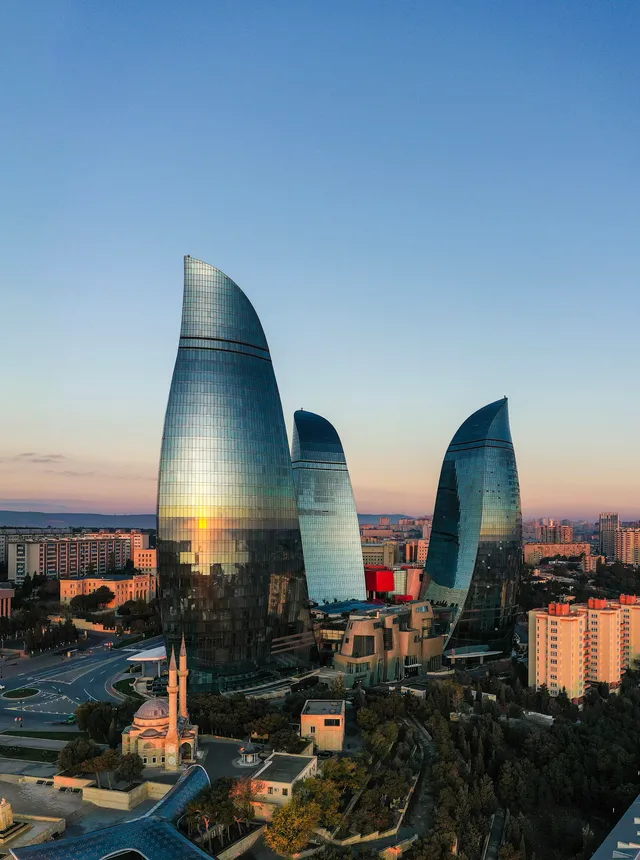
A Turkic state on the Caspian shore in the south-east of the Caucasus. The country that founded the first democratic republic of the Muslim East in 1918 restored its independence in 1991. Population 10.26 million; capital Baku.
The Republic of Azerbaijan lies in the east of the South Caucasus, on the western shore of the Caspian Sea. It covers 86,600 square kilometres and had 10,262,351 inhabitants on 1 January 2026. The capital is Baku, the state language is Azerbaijani and the currency is the manat. The country includes the Nakhchivan Autonomous Republic.
History
In antiquity these lands were home to Manna, Atropatene and Caucasian Albania; in the Middle Ages to the Shirvanshahs, the Atabegs, the Kara Koyunlu, the Ak Koyunlu and the Safavids. In the 18th century the country split into khanates, and early in the 19th century its northern lands were annexed by the Russian Empire.
On 28 May 1918 the Azerbaijan Democratic Republic was proclaimed — the first democratic republic of the Muslim East. It fell to Soviet occupation in April 1920. Azerbaijan restored its independence on 18 October 1991, and the first Constitution of the independent state was adopted in 1995.
Karabakh and the surrounding districts remained under Armenian occupation for almost 30 years. As a result of the 44-day Patriotic War in 2020 and the local anti-terrorist measures of September 2023, sovereignty was restored over the country's entire territory.
Geography
The Greater Caucasus runs along the north, the Lesser Caucasus along the west, and the Kura-Araz lowland fills the centre. The highest peak is Bazarduzu (4,466 m). According to Azerbaijani sources, 9 of the world's 11 climate types occur in the country — from subtropical Lankaran to snow-capped summits.
Government
Azerbaijan is a presidential republic, with legislative power held by the Milli Majlis. It is a secular state, and the great majority of the population is Muslim. Azerbaijan is a founding member of the Organization of Turkic States and has chaired it since October 2025.
Economy
Oil and gas are the backbone of the economy. The well drilled at Bibi-Heybat in 1846 is counted among the world's first industrially drilled oil wells. Today oil from Azeri-Chirag-Gunashli and gas from Shah Deniz reach Europe through the Baku–Tbilisi–Ceyhan pipeline and the Southern Gas Corridor. Hazelnuts, cotton, grapes and pomegranates, the chemical industry and tourism are also important.
Sources
Updated: October 1, 2026